Description
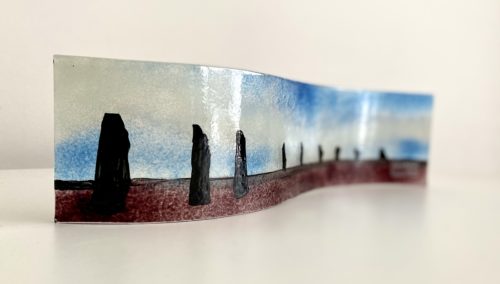
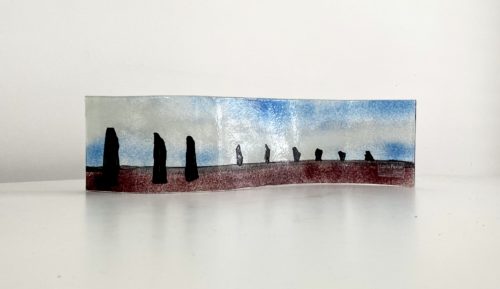
I have a lot of these small panels (around 10 x 11 cms) although some are slightly bigger.
All of them slot into a wee oak stand, provided.
I painted these loosely using clear glass and kiln fired them with frits and enamels.
The Italian Chapel consists of two Nissen huts transformed into a beautiful chapel by Domenico Chiocchetti and his colleagues, Italian prisoners of war captured in North Africa and transported to the Island of Lamb Holm in Orkney.
In October 1939 a German submarine under the command of Gunther Prien entered Scapa Flow and sank the British battleship ‘HMS Royal Oak’ with the loss of 834 lives. Winston Churchill, at that time First Sea Lord, visited Orkney and the decision was taken to construct barriers to close off four of the entrances to Scapa Flow to make the base for the home fleet more secure.
A shortage of manpower to construct the barriers coincided with the capture of thousands of Italian soldiers fighting in North Africa, so a decision was taken to transport 550 men to Camp 60 on Lamb Holm and a similar number to Camp 34 in Burray.
Following a request from the camp priest, Fr Giacobazzi, it was agreed that two Nissen huts would be joined together to provide a chapel. Among the Italians in Camp 60 was an artist, Domenico Chiocchetti, and he was given the task of transforming the two Nissen huts into a chapel. He was assisted by other tradesmen – in particular Giuseppe Palumbi, a blacksmith, and Domenico Buttapasta, a cement worker.
Domenico Chiocchetti carried in his pocket a small prayer card given to him by his mother before he left his home in Italy, and it was the image on that card of the Madonna and Child by Nicolo Barabino that Chiocchetti based his painting above the altar in the Chapel. When the Camp Commander, Major Buckland, realised that the prisoner was a very talented artist he was allowed to continue painting to make the building more attractive.
Now, decades after the completion of the Chapel, it is one of Orkney’s most loved attractions.