

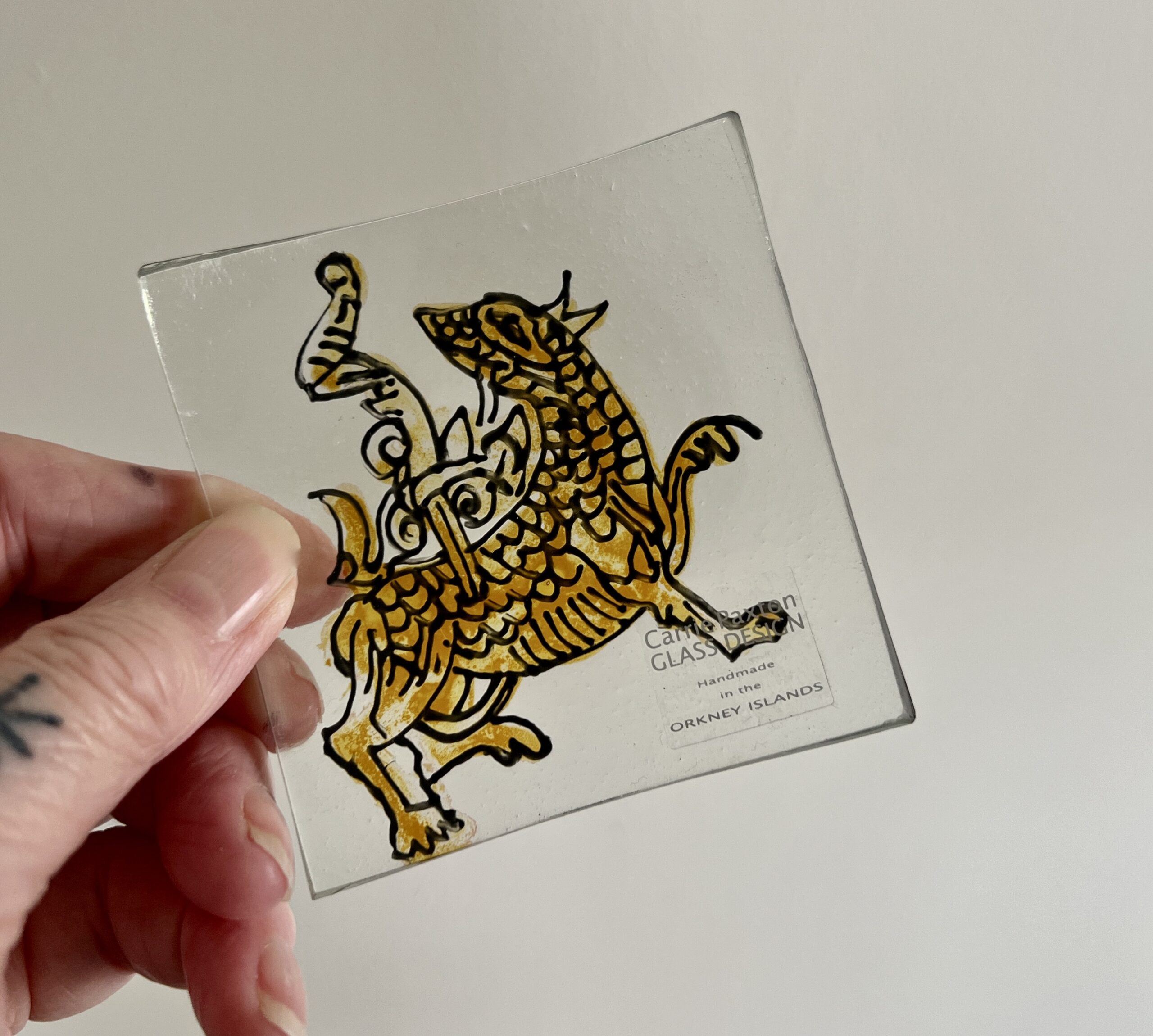
Description
This is new design (for me)- but it is derived from Viking graffiti carved around the 12th century and found in Maeshowe Tomb.
The wee dish measures approximately 8 x 8 cm.
Maeshowe, the great Neolithic chambered tomb was built around 5000 years ago.
I made this using clear glass and drew the dragon in enamel onto the surface. It’s quite fiddly getting the fine detail onto the glass. I kiln fired this and added silver stain to the back of the glass. I use silver stain as I felt the colour suited the ancient dragon. Silver stain, when fired can vary from yellow to brown. This appealed to me as its variation in shade matched the image, at least in my head it did!
Silver stain, also known as yellow stain, is used to create a yellow colour on clear glass. The technique of silver stain was introduced to stained glass in the early 1300s and involves painting silver compounds (such as silver nitrate, chloride, sulphate or oxide) onto a piece of glass and then firing it in the kiln. Silver staining is the technique from which the term ‘stained glass’ derives
This is kiln fired and includes slumping the glass into a ceramic mould. This gives the glass a curved edge and a flat base which sits well on a surface.
Among the runic inscriptions left by the Vikings, one stands out: the famous Maeshowe Dragon. This serpentine creature, carved with skill and imagination, has become an icon of the site. Its sinuous form, with interlaced patterns typical of Norse art, sprawls across the stone, guarding the ancient chamber with its fearsome visage.
The dragon, possibly a representation of the Norse mythological creature Jörmungandr, the Midgard Serpent, showcases the artistic prowess of its creator. Its presence in Maeshowe may have been intended as a protective symbol, or perhaps it was carved to mark the Vikings’ conquest of this ancient and mysterious place.


